
Understanding Incoterms: The Rules Governing Every Export Deal
Every international sale of goods raises the same three questions:
- Who arranges and pays for logistics?
- At what exact point does risk pass from seller to buyer?
- Who handles customs clearance on each end?
International Commercial Terms (Incoterms for short) exist to answer these questions in a standardized way, so a seller in Kano, Nigeria and a buyer in Rotterdam or Mumbai are working from the same rulebook rather than negotiating ambiguous shipping language from scratch.
What Incoterms Actually Are
Incoterms are a set of eleven three-letter trade terms published by the International Chamber of Commerce (ICC). The current edition, Incoterms 2020, took effect on January 1, 2020, and remains the version in use today. The ICC typically revises the rules only once a decade, so the next update isn't expected until around 2030.
Incoterms DO NOT determine when ownership of the goods transfers; they don't set the price or payment terms, and they say nothing about what happens if one party breaches the contract. Those matters belong in the sales contract itself. What Incoterms define precisely is the division of cost, risk, and responsibility for transport and customs between buyer and seller.
The Two Families of Terms
The eleven terms are split into two groups based on the mode of transport they're built for.
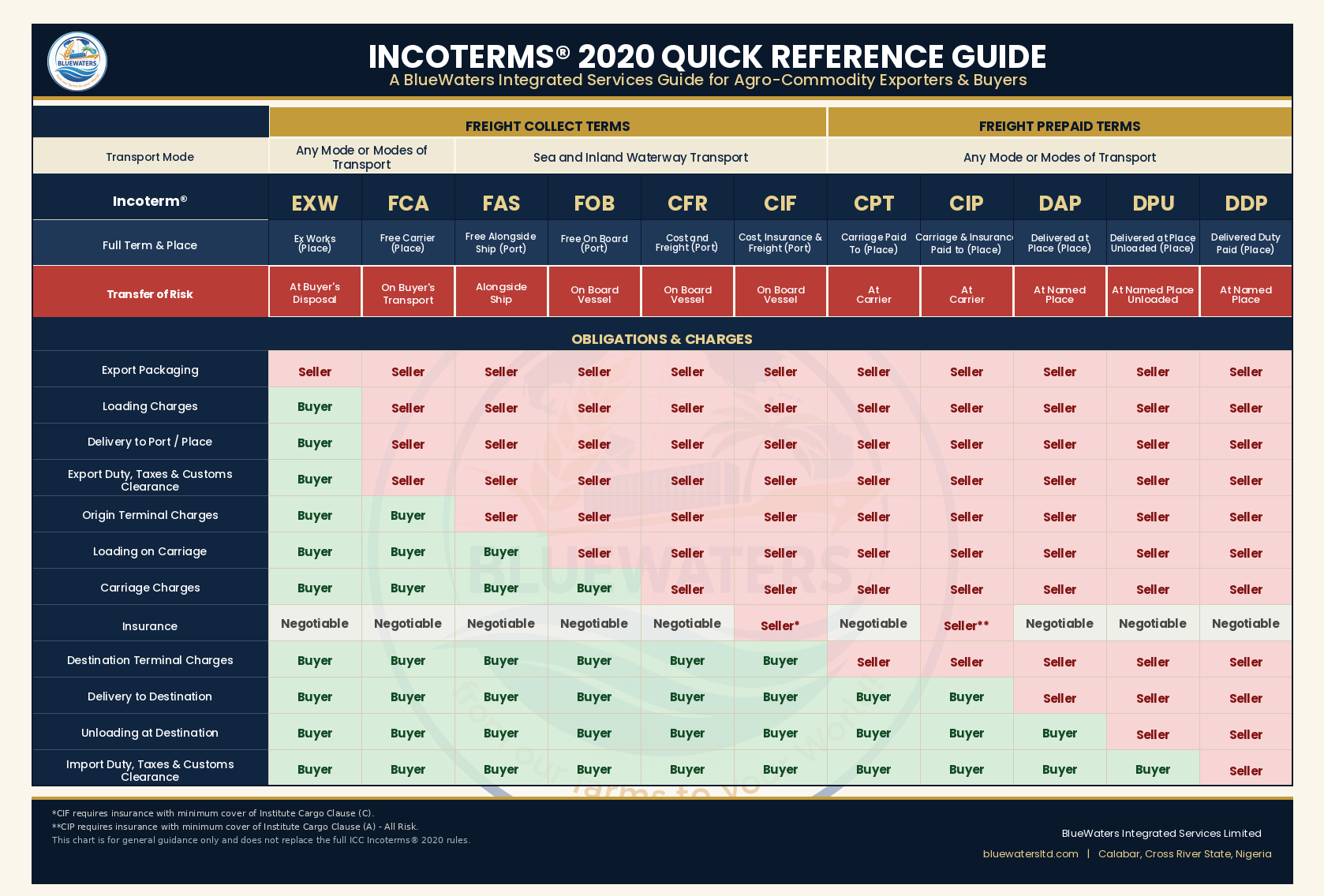
Rules for any mode of transport (seven terms) work whether goods travel by road, rail, air, sea, or a combination. This makes them the right choice for containerized cargo:
EXW (Ex Works): The seller's only obligation is to make the goods available at their own premises; the buyer assumes virtually everything else, including loading.
FCA (Free Carrier): The seller delivers the goods, cleared for export, to a carrier or place named by the buyer.
CPT (Carriage Paid To): the seller pays for transport to the named destination, but risk transfers once goods are handed to the first carrier.
CIP (Carriage and Insurance Paid To): like CPT, but the seller must also arrange insurance, and Incoterms 2020 raised the required insurance coverage level for this term specifically.
DAP (Delivered at Place): the seller bears risk and cost until the goods arrive at the named destination, ready for unloading.
DPU (Delivered at Place Unloaded): similar to DAP, but the seller is also responsible for unloading the goods; this term replaced DAT from the 2010 edition.
DDP (Delivered Duty Paid): the seller's maximum obligation: they cover transport, export and import clearance, and duties, delivering the goods ready for the buyer to simply receive.
Rules for sea and inland waterway transport only
Four terms are built specifically around a vessel and a port, so they should never be used for containerized cargo that travels part of its journey by truck or rail to an inland depot:
FAS (Free Alongside Ship): the seller delivers goods alongside the vessel at the named port.
FOB (Free on Board): risk transfers once the goods are loaded onto the vessel; the buyer takes over shipping costs and insurance from that point.
CFR (Cost and Freight): the seller pays for transport to the destination port, but risk transfers once goods are on board.
CIF (Cost, Insurance, and Freight): like CFR, but the seller must also arrange insurance covering the buyer's risk during transit.
Why the Distinction Matters in Practice
Using a sea-only term for cargo that actually moves a container by truck is one of the most common and costly mistakes in trade contracts. A container is typically handed over to a carrier at an inland depot, not "loaded on board a vessel," as FOB or CIF assume. When the actual logistics don't match the legal language of the term, the result is ambiguity about exactly when risk passed, which becomes expensive precisely when something goes wrong: a container damaged before it reaches the port, for instance, could have both sides pointing to a different reading of "on board."
For agro-commodities, exporters shipping bulk or bagged product, bitter kola, ginger, and similar goods, FOB and CIF remain the most commonly used terms, since these shipments typically move as break-bulk or full containers loaded directly for sea freight from a port. Under FOB, the exporter's responsibility (and cost) ends once the goods are loaded onto the vessel; the buyer arranges and pays for the ocean freight and insurance from that point. Under CIF, the exporter goes a step further, also arranging and paying for the shipping cost and marine insurance to the destination port, even though risk still passes to the buyer once goods are on board. Many overseas buyers request CIF quotes specifically because it simplifies their side of the transaction, even though it shifts more logistics coordination onto the exporter.
How Incoterms Show Up in Your Documents
The chosen Incoterm isn't just a clause buried in a contract; it shapes several of the shipping documents that follow. It determines who is responsible for arranging the marine insurance certificate (mandatory for the seller under CIF and CIP). It dictates who books and pays for the freight reflected on the Bill of Lading. And it's typically stated directly on the commercial invoice, since customs authorities on both ends use it to understand how the declared value was calculated, whether freight and insurance are already included in the price or not.
Getting the Wording Right
A vague reference like "CIF Hamburg" invites disputes, because it doesn't specify which edition of the rules applies. The safer practice is to name the term, the precise location, and the edition together, for example: "CIF Hamburg, Incoterms 2020." For DDP, DAP, and DPU shipments, naming the exact delivery point (a warehouse address, not just a city) similarly leaves no room for argument later about whether "arrival" meant the port, the depot, or the buyer's door.
The Bottom Line
Incoterms exist to remove exactly the kind of disagreement that surfaces after something has already gone wrong: a shipment delayed, damaged, or held at customs, with each side assuming the other was responsible. Choosing the right term for your mode of transport, stating it precisely with the current edition, and understanding how it maps onto your actual shipping documents is one of the simplest ways an exporter can prevent a dispute before it starts. For any given deal, the "best" Incoterm isn't universal; it depends on how much logistics coordination you want to handle yourself versus hand to the buyer, and getting that balance right is as much a commercial decision as a legal one.
Request an FOB or CIF QuoteReferences
- [1]O'Connor E, Lowe D, Vanheusden K. Incoterms 2020 Checklist + Flowcharts: Choosing the Right Incoterms Rule. International Chamber of Commerce. ISBN: 978-92-842-0626-1.